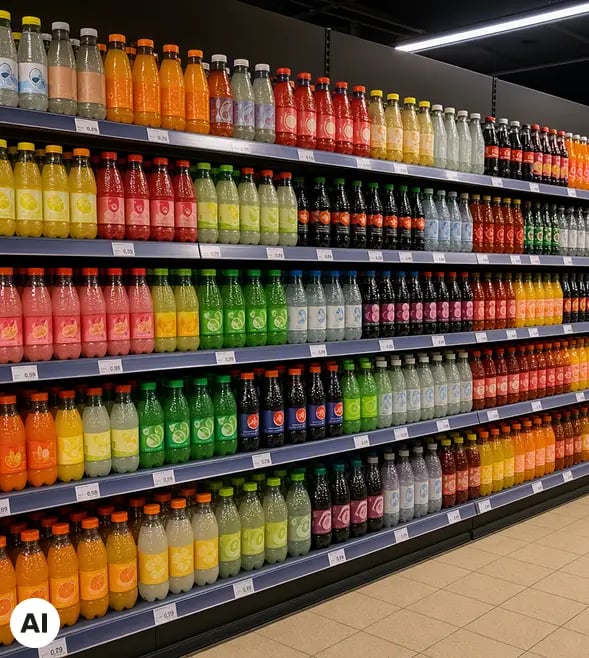
The Federal Government is pushing forward with the introduction of a tax on sugary drinks. According to the basic information released so far, starting from 2028 the tax is to have an effect as a tool to direct health policy and at the same time generate more income for public budgets or the health system. But the current discussion is already showing that the scope, assessment basis and product categories are politically contentious.
Background to the planned sugar tax
As part of its budget and health reforms, the Federal Government is planning to introduce an excise tax on sugary drinks. The example for this is the British model, which sets incentives to reduce sugar content by means of staggered levies.
According to Federal Government figures, yearly income of around 450 million euros is expected. Added to this are potential savings to the health system resulting from lower consumption of heavily sweetened drinks.
At the same time, the specific form the tax will take is being discussed within the Federal Government. While the focus was originally on standard soft drinks, current suggestions indicate that in future other product groups like ice tea, dairy drinks, oat drinks, and drinks containing sweeteners may be included.
Economic impact on companies
There are already areas for producers, importers and retailers to take action on.
Adapting product portfolios
International experience shows that sugar taxes often result in recipes being modified. Companies face the challenge of reducing sugar content without adversely affecting taste, brand identity and consumer acceptance.
Impact on pricing and margins
Depending on the size of the tax liability, the question is whether the additional costs will be passed on to consumers or partly absorbed by companies. Particularly in price-sensitive segments, this can put substantial pressure on margins and competitiveness.
Tax and administrative requirements
New excise taxes are typically accompanied by additional reporting, documentation and evidence requirements. Companies should check now:
- which products could be affected
- how the sugar content can be calculated in an auditable way
- what changes need to be made in ERP and tax compliance systems
- what effects will arise in supply chains and import processes.
Risks to international groups of companies
Companies with cross-border distribution structures will have to take account of the potential interplay between existing sugar and soft-drink taxes in other European markets. Harmonising product data and tax processes early can reduce implementation expenses later.
Strategic opportunities arising from sugar tax
Along with the additional burdens, the planned regulation also provides opportunities:
- to develop low-sugar product lines
- to strengthen health-aware brand positioning
- to use innovation and sustainability strategies in order to differentiate
- to break into new customer groups that have health-aware consumption patterns.
- International examples show that manufacturers that bank on reformulation and innovation can partly compensate for any tax drawbacks.
Recommendations for action for affected companies
Even if the final legal form is still open, companies should already start making preparations:
- Conduct a tax assessment for products in the existing portfolio.
- Analyse potential tax liabilities using various scenarios.
- Review the quality of data and product master data concerning sugar and sweetener content.
- Evaluate potential new recipes and product modifications.
- Prepare tax compliance processes and IT systems.
- Continue to observe the legislative process.
Conclusion
The planned sugar tax is increasingly developing from a discussion on public health to a topic relevant to the food and drinks sector in terms of tax and strategy. Regardless what form it ultimately takes, the pressure of regulation on sugary products is set to rise. Companies are therefore well advised to analyse potential effects early and lay the tracks to implement the sugar tax in terms of tax, operations and strategy.
Authors
-

Andreas Clouth
Andreas Clouth is a Partner in indirect tax focusing on customs and excise duties and related topics, such as emissions trading and CBAM.View Profile -

Fabian Greco
Fabian Greco works in the Indirect Tax department (VAT) at the Duesseldorf and Munich office. He has several years of experience in advising national and international clients of all sizes on VAT issues.View Profile -

Ilija Jovanovic
Ilija Jovanovic is Senior Manager in the Indirect Tax team at the Düsseldorf office, advising companies on customs and excise duty matters.View Profile