German Dividend Withholding Tax: A New Route to 0% for U.S. Groups

By: Lukas Kawka
25 Nov 2026 4 min read

A new, unpublished approach applied by the German Federal Central Tax Office (BZSt) may allow U.S. groups to obtain a full exemption where German dividend withholding tax relief has previously been limited to 5%. It may also enable qualifying groups to secure 0% relief upfront, avoiding a separate refund claim for the final 5%.
The existing framework
Dividend distributions by German companies to their U.S. shareholders are generally subject to German withholding tax of 26.375%. Under the U.S.–Germany tax treaty (“DTT”), this rate may be reduced to 15%, 5% or, in certain cases, 0%.
Relief at source requires an application by the shareholder and prior approval from the BZSt in the form of a valid withholding tax exemption certificate.
The 5% treaty rate generally applies to a qualifying corporate shareholder directly holding at least 10% of the voting stock of the German subsidiary. For a full corporate exemption under Article 10 (3)(a) DTT, the U.S. company must beneficially own the dividend and directly hold at least 80% of the voting power for the 12 months ending on the date its dividend entitlement is determined.
It must also qualify under one of the specified limitation-on-benefits routes and satisfy Germany’s anti-treaty-shopping requirements under Section 50d(3) EStG.
One route, Article 10 (3)(a)(bb) DTT, combines the following tests:
- Qualifying ownership. Broadly, at least 50% of each class of shares must be held by qualifying U.S. residents for at least half the taxable year, with additional conditions for indirect ownership.
- Base erosion. Less than 50% of annual gross income may be paid or accrued as relevant tax-deductible payments to nonqualifying recipients, subject to specific exceptions.
- Active business. The dividend must be connected with, or incidental to, an active U.S. trade or business under Article 28 (4) DTT.
Other treaty routes are available, including for qualifying publicly traded groups and under the derivative benefits provisions.
Why full relief has been difficult to obtain
The qualifying ownership requirements can be difficult to document, particularly in private equity structures where evidence of the ultimate investors’ U.S. tax residence and treaty eligibility may be unavailable. Complex U.S. ownership structures involving trusts can present similar challenges.
Where these requirements could not be demonstrated and no other full-exemption route was available, relief was generally limited to 5%.
Even shareholders able to meet the conditions for 0% relief often could not obtain it upfront under the ownership and base erosion route. Compliance with the base erosion test generally had to be verified using information for the completed dividend year.
In such cases, shareholders first applied for an exemption reducing withholding tax to 5%. Following a dividend distribution, they then had to wait until year-end and submit a separate refund application for the remaining 5%, supported by the necessary evidence. Processing that application often took several months.
Full relief was therefore administratively burdensome and, for some ownership structures, unavailable.
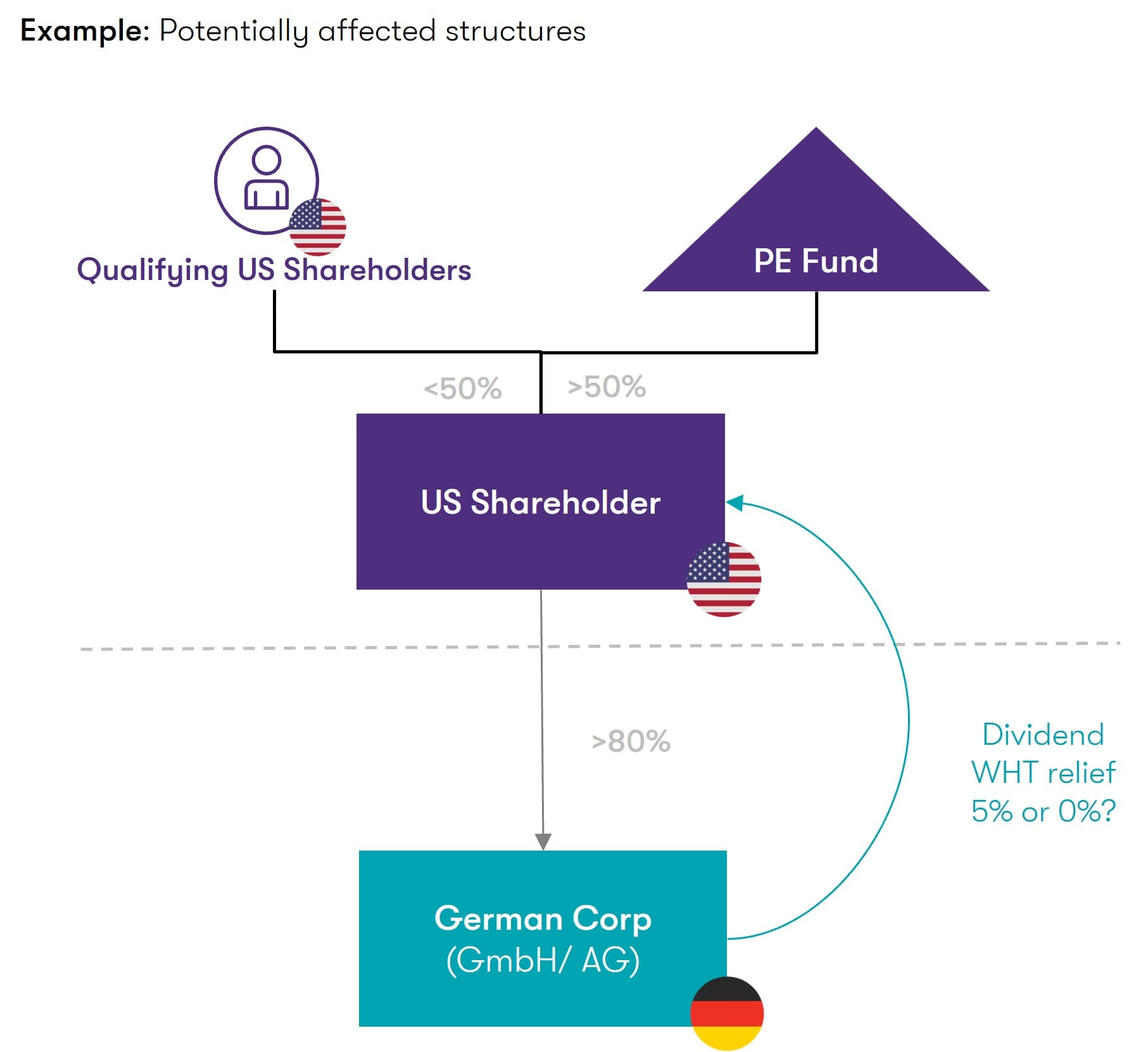
Example of a potentially affected U.S.–German ownership structure.
An additional route under current BZSt practice
Under a new, unpublished administrative approach currently applied by the BZSt, full relief may now be granted by way of discretionary relief (Article 28 (7) DTT in conjunction with Article 10 (3)(a)(dd) DTT).
This approach applies where the active trade or business test and the other applicable requirements are met. In qualifying cases, the BZSt generally considers this route on its own initiative as part of the exemption procedure.
The underlying rationale is that qualifying active business operations and the relevant connection to the German income support the conclusion that the structure is not being used for treaty shopping. This can justify full relief even where the strict ownership and base erosion route is unavailable.
This practice has not been published in general administrative guidance. Relief remains a BZSt determination rather than an automatic entitlement.
The 80% direct voting ownership threshold, the 12-month holding period and the other applicable requirements, including Section 50d(3) EStG, continue to apply.
Which groups should review their position?
The opportunity is particularly relevant to U.S. corporate shareholders that currently receive only 5% relief because of their ownership structure, including groups with private equity investors, and those seeking to replace the 5%-plus-refund process with an upfront exemption.
The active business test requires more than a U.S. holding company. Qualifying activities of connected group companies can be relevant, but the relationship between the U.S. and German businesses and the relative scale of their activities must be assessed. Investment holding or management alone does not generally satisfy the test.
Recommended next steps
U.S. groups should review their current German dividend withholding tax position. If relief has so far been limited to 5%, it is worth checking whether the new approach could allow a reduction to 0%.
Groups that already qualify for 0% relief but currently have to claim a refund should also consider updating their exemption certificates. This could allow full relief upfront, avoiding the separate refund process.
A valid BZSt exemption certificate covering the dividend payment is required before withholding can be reduced to 0%. An existing 5% certificate does not automatically provide full relief.
We would be happy to review your group’s position and assist with the exemption application. Please get in touch to discuss your options.
Authors
-

Lukas Kawka
Lukas Kawka is a partner in the International Tax service line at our Berlin office. He has extensive experience advising clients on both national and international corporate tax matters.View Profile