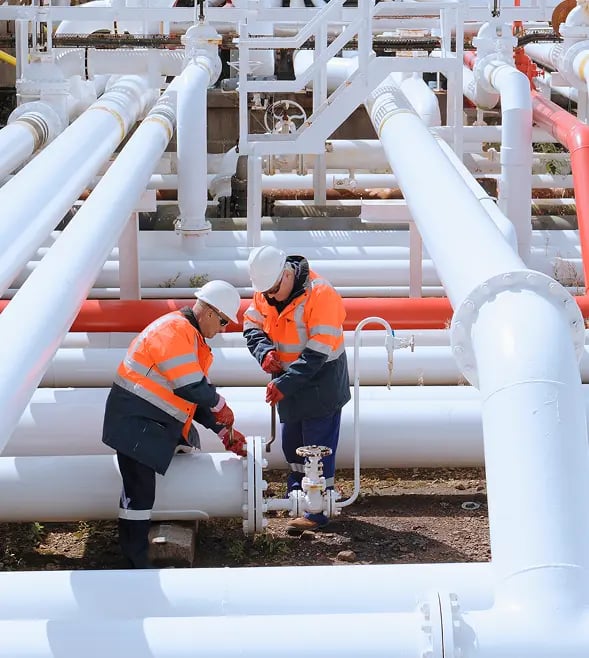
The planned discontinuation of natural gas is having a significant impact on the use of existing natural gas infrastructures, particularly gas networks. In light of this, many network operators are increasingly facing the question of how gas networks are to be treated for accounting if their economic useful lives are shortened or if decommissioning is expected.
The first indications are provided by current opinions from the Bundesnetzagentur (BNetzA) and the Institute of Public Auditors in Germany (IDW) – since there is no Federal Ministry of Finance Circular on the matter, treatment in tax accounts remains open. This uncertainty is a big challenge particularly to companies that wish to have their financial statements and tax accounts aligned with each other.
Shortened useful life and depreciation of gas networks
The goal of net greenhouse gas neutrality by 2045 laid down by the Federal Climate Change Act (Bundesklimaschutzgesetz) means that a considerable part of the gas network will not be able to be used beyond 2045. Due to the shorter useful lives of the gas networks resulting from this, the question is whether and to what extent existing depreciation arrangements must be adjusted.
The starting point for the current discussion is statements by the Bundesnetzagentur on the depreciation arrangements as part of net tariff regulation. The Bundesnetzagentur has set the conditions for calculating the upper income threshold for the calendar year, from which the grid fees are derived, and in the determination proceedings for the adjustment of imputed useful lives and depreciation arrangements for natural gas pipeline infrastructure (KANU 2.0) now allows shorter useful lives of gas networks to be taken into account. Structuring the network tariffs is meant to prevent network users that only stop using natural gas towards the end of the transformation process from being unduly burdened.
Depreciation in the financial statements
The Institute of Public Auditors in Germany (IDW) considers that there is no direct internal connection between the contents of the depreciation arrangements and depreciation under accounting law. But the planned discontinuation of the natural gas supply raises the question whether the depreciation arrangements up till now can be maintained unchanged. A shortened depreciation period must be based on objective indications and justified expectations for the individual case; for example, planned conversion for later use with hydrogen must be taken into account, which may lead to the end of the consistent link between the use and function of the gas network that existed until now. As well as the adjustment to useful lives, a change from straight-line depreciation to declining balance depreciation can also be considered to properly reflect the expected decline in the number of network users in the financial statements.
Depreciation in the tax accounts
As a rule, recognition in the financial statements also determines the tax accounts, although special tax rules must be observed for depreciation and provisions. There is currently no statement from the tax authorities, e.g. in a Federal Ministry of Finance Circular, whether a shortening of the depreciation period or a write-down to fair value on gas networks in the tax accounts is permitted. The tax accounts continue to be determined by the official tax depreciation tables. Particularly in cases in which a shortened useful life is assumed for the purposes of the financial statements, this now raises the question whether the decision can be ignored for the tax accounts. It should in any case be possible to explain to the tax office any deviation from the useful life according to the official tax depreciation tables in any particular case.
The uncertainty that exists is compelling affected companies to check and document their treatment in their tax accounts closely. This particularly applies to cases in which the financial statements and tax accounts are to be in alignment with each other. It remains to be hoped that the tax authorities will soon clarify the situation in a Federal Ministry of Finance Circular.
Provisions for obligations to decommission gas networks
The planned discontinuation of the natural gas supply is increasingly placing a focus on provisions for decommissioning obligations. A particular condition for recognising a provision is the existence of a legal or actual external obligation and the probability that it will be enforced.
Financial statements
In the past forming a provision for contingent liabilities was often not undertaken because it was assumed that the gas network would be used permanently (presumption of perpetuity) and that the reporting party did not seriously have to expect that decommissioning obligations would be enforced. The IDW considers that this presumption of perpetuity can no longer be held to because the use of gas will be discontinued, meaning the recognition of a provision for a liability can now be considered. However, the recognition of a provision should be checked with regard to a change of use, decommissioning or deconstruction of a network (or part of one). For decommissioning obligations in particular whether there is an outside obligation (e.g. does an owner have a right of removal or is there a duty to tolerate it?) and the probability of it being enforced must be critically considered. A draft bill published at the end of 2025 by the Federal Ministry for Economic Affairs and Energy lays down in a section 48a for the Energy Act [Energiewirtschaftsgesetz – EnWG] a (statutory) duty to tolerate decommissioned pipelines in the ground, so forming provisions for decommissioning should in future only be limited to individual cases.
Tax accounts
Because the financial statements are determinative, a provision for decommissioning obligations should also be recognised on its merits in the tax accounts, observing the particular measurement rules of tax law. However, the tax authorities have not given an opinion on the area of provisions either, and there are good reasons to assume that the tax authorities will take a strict attitude towards decommissioning obligations in particular.
Owing to the uncertainty currently surrounding the permissibility of recognising a provision in the tax accounts, it is urgently recommended to carefully check and document the formation of a provision in order to be able to explain it to the tax office.
RECOMMENDATION FOR ACTION
The discontinuing of the natural gas supply by 2045 is leading to numerous regulatory and accounting issues. According to the determinations made by Bundesnetzagentur, the useful life of gas networks can be adjusted to determine depreciation arrangements. In the financial statements, too, the IDW considers that depreciation can be based on a shortened useful life or modified depreciation plan. For tax accounts, the tax authorities have not yet declared their position, so there continues to be uncertainty whether deviating from the official tax depreciation tables is permitted. It is also unclear concerning the recognition of provisions for decommissioning whether recognition in the financial statements can be assumed.
When the depreciations and provisions in the financial statements are to be included in the tax accounts, the conditions have to be checked and documented in each case so they can be explained to the tax office. Owing to the continuing uncertainties in tax law, the obligation to state reasons is a demanding task for the companies affected.
We’ll be glad to be your contact to answer your queries on this topic. We’re looking forward to hearing from you!
-
 Dr Gregor Weimer Dr Gregor Weimer is a lawyer, tax adviser, German Public Auditor as well as a specialised tax lawyer and works as a partner in the Tax department in Berlin.
View Profile -
 Christoph Heinrich Christoph Heinrich has around 25 years of professional experience in advising and auditing of annual and group financial statements for medium-sized and large companies with an international orientation.
View Profile